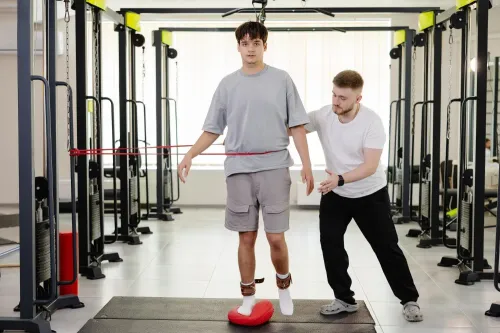

Choosing a strength-conditioning provider depends on more than access to weights: your training history, symptoms, sport, age, work demands, and recovery needs all affect the right programme. By comparing assessment methods, exercise progression, sport-specific planning, and supervision, you can identify a suitable option in Vadodara and avoid a generic routine that does not match your body or goals.
Key takeaways
- Match resistance, speed, range, and recovery to your specific goal.
- Request screening for pain, injury history, movement limits, and training demands.
- Choose a provider with sport-specific progression and measurable reassessment.
- Stop and seek assessment for sharp pain, numbness, swelling, or loss of strength.
What strength conditioning should mean for your body and goals
Strength conditioning is planned resistance, aerobic, balance, agility, and task-specific work that improves how your body produces and controls force. It is not simply lifting heavier weights: the load, speed, range, recovery, and progression must match your goal, whether you are a healthy adult, recreational athlete, older adult, or returning after injury.
| Option | Main focus | What makes it different |
|---|---|---|
| Gym training | General exercise using machines, free weights, or classes | You often choose the exercises and progression yourself; injury history and sport demands may receive little attention. |
| Personal training | Individual coaching during workouts | A trainer can improve technique and motivation, but clinical assessment and rehabilitation are outside the role unless the professional is also qualified for them. |
| Sports coaching | Sport skills, tactics, speed, and competition performance | It develops sport performance; it is not automatically designed to manage pain, surgery recovery, or movement limitations. |
| Rehabilitation physiotherapy | Restoring function after pain, injury, surgery, or neurological illness | Exercise is selected around symptoms, impairments, and daily tasks, then progresses toward normal training. |
| Strength conditioning | Capacity, resilience, and performance for a specific person and task | It connects assessment with progressive strength, conditioning, movement control, and injury-risk management. |
For strength conditioning for fitness and injury prevention in Vadodara, look for a programme that trains all major muscle groups at least twice weekly and includes sport or work demands. Physiotherapy strength training in Vadodara is the better starting point when pain, weakness, surgery, balance problems, or neurological limitations affect exercise choice.
Who benefits from supervised conditioning in Vadodara?
Supervised conditioning benefits anyone whose exercise plan must change with age, fitness, injury history, work demands, sport, pain, or a specific goal. The right programme builds capacity without treating every person like a healthy competitive athlete.
| Your situation | Programme emphasis | What supervision changes |
|---|---|---|
| New or low fitness | Full-body strength twice weekly, aerobic work, balance, and gradual loading | Controls pace, technique, and recovery |
| Older adult | Leg strength, balance, walking capacity, power, and fall-risk tasks | Scales resistance and provides support |
| Previous injury or surgery | Restore movement, strength, control, and confidence before heavier or faster work | Sets progression limits and liaises with your doctor or surgeon |
| Runner, cricketer, footballer, or racket-sport athlete | Sport-specific impact, deceleration, lunging, rotation, and shoulder or calf capacity | Reproduces demands instead of relying on stretching alone |
| Desk-based or manual worker | Trunk, hip, shoulder, grip, lifting, and posture endurance | Fits exercises around shifts, travel, heat, and available equipment |
For fitness injury prevention in Vadodara, choose a plan you can follow: WHO recommends 150–300 minutes of moderate aerobic activity weekly, alongside muscle strengthening. A home routine matters when commuting, work hours, or limited equipment make frequent clinic visits impractical.
Training fatigue and delayed-onset soreness are different from sudden sharp pain, swelling, bruising, locking, giving way, numbness, progressive weakness, or pain that changes your gait. Stop and seek reassessment for those signs rather than adding load.
What a proper pre-training assessment should include
Before prescribing resistance or conditioning work, a clinician should establish what you can safely tolerate today, not guess from age or appearance. An assessment for strength conditioning physiotherapy in Vadodara should connect your symptoms, function, medical history, work, and sport demands to a measurable starting point.
- Record your goals, current activity, training schedule, occupation, sport, previous injuries, surgeries, medical conditions, and medications.
- Check pain behaviour and warning signs, including swelling, bruising, joint locking or giving way, numbness, progressive weakness, and pain that changes your gait.
- Measure joint range of motion, movement quality, posture, balance, single-leg control, core endurance, and task-specific control such as a squat, step-down, lift, or landing.
- Test strength without assuming that one weak side or flexibility difference predicts injury; interpret asymmetry alongside pain, function, and movement tolerance.
- Assess cardiovascular tolerance, breathing response, fatigue, recovery, and the load you can handle with controlled technique.
- For older adults, examine transfers, stepping, balance reactions, and confidence with daily tasks, not only machine-based strength.
Normal training fatigue or delayed-onset muscle soreness should improve with recovery. Sudden sharp pain, increasing swelling, new bruising, locking, giving way, numbness, or worsening weakness calls for reassessment.
After surgery, the clinician must follow the surgeon’s protocol for wound status, weight-bearing, range of motion, resisted exercise, and return-to-sport timing. Generic strengthening is not a safe substitute for surgical clearance.
What happens in a strength-conditioning session?
A well-run session combines preparation, observation, training, and recovery in one appointment. The sequence protects technique and lets the clinician adjust the plan before fatigue turns into an avoidable setback.
1. Warm-up raises body temperature and prepares the nervous system through easy aerobic work, balance, agility, and sport-specific movements.
2. Movement screening checks how you control key tasks, such as a squat, hinge, lunge, or single-leg stance. The clinician watches technique, symptoms, balance, and joint control rather than treating one asymmetry as proof of injury risk.
3. Resistance work develops strength with a load you can control. Exercises may use body weight, bands, machines, free weights, or cables.
4. Conditioning builds work capacity through intervals, circuits, or steady effort matched to your sport, job, age, and current fitness.
5. Mobility work addresses restrictions that affect the session, while avoiding aggressive stretching into pain.
6. Recovery includes breathing, easy movement, symptom review, and instructions for hydration, sleep, and the next training day.
7. Progression increases resistance, repetitions, volume, range, speed, or exercise complexity only when technique, symptoms, and recovery support it.
Good physiotherapy strength training in Vadodara also distinguishes normal fatigue or delayed-onset soreness from sharp pain, swelling, bruising, locking, giving way, numbness, or worsening weakness. Those signs require reassessment. After surgery, follow the operation-specific protocol for weight-bearing, range of motion, wound status, and return to sport instead of using a generic programme.
How to choose a provider for your sport, routine, and safety needs
A good sports conditioning clinic in Vadodara should show how it will prepare you for your actual demands, not sell one routine to every client. Ask how it assesses movement, strength, balance, symptoms, training history, work demands, and previous surgery before prescribing exercises.
| Activity | Capability to check | Warning sign |
|---|---|---|
| Running | Graded impact, calf and hip capacity, single-leg control | Immediate mileage increases |
| Cricket | Sprinting, throwing, rotation, change-of-direction work | Only general weight training |
| Badminton | Lunging, deceleration, ankle control, shoulder-load tolerance | Stretching without landing practice |
| Football | Agility, acceleration, braking, and repeated-effort conditioning | No return-to-play stages |
| Cycling or gym training | Posture, joint loading, trunk and lower-limb strength | Focus on visible muscles alone |
| Desk work | Tolerance for prolonged sitting, mobility breaks, and practical home exercises | A programme you cannot fit around work |
| Post-injury recovery | Operation-specific restrictions and communication with your treating team | Generic strengthening before clearance |
Before choosing, ask for:
- A written progression: warm-up, resistance, conditioning, recovery, and criteria for increasing load.
- Supervised technique and a home plan that matches your equipment, travel, heat exposure, and schedule.
- Clear escalation rules for increasing pain, swelling, dizziness, numbness, or loss of function.
- Evidence that the provider uses sport-specific drills rather than generic stretching alone.
For strength conditioning for fitness and injury prevention in Vadodara, Physiospace By Dr. Pratiksha is worth assessing against these practical standards. The right choice for fitness injury prevention in Vadodara is the provider that can adapt training while keeping safety decisions explicit.
Related services
Sports & Fitness Rehabilitation Physiotherapy in Vadodara is a specialized rehabilitation and performance enhancement service designed to improve strength, mobility, endurance,... View service → |
Personalized Exercise Programs Stretching & Strengthening Exercises Physiotherapy – Improve Flexibility, Strength & Mobility At Physiospace By Dr. View service → |
Frequently asked questions
What does strength conditioning include?
It combines planned resistance, aerobic, balance, agility, and task-specific exercises with controlled progression, recovery, and technique.
Who benefits from supervised strength conditioning in Vadodara?
Healthy adults, recreational athletes, older adults, and people returning after injury can benefit when training is matched to their abilities and goals.
What should a pre-training assessment cover?
The assessment should review your medical and injury history, pain, mobility, strength, balance, movement control, fitness, and the demands of your sport or routine.
What happens during a strength-conditioning session?
A session can include warm-up, technique practice, resistance or aerobic work, balance and agility drills, task-specific exercises, and a progression plan.
How do you choose a strength-conditioning provider?
Compare assessment quality, supervision, exercise progression, sport or rehabilitation experience, communication, safety procedures, and reassessment methods.
Related services
Orthopedic Rehabilitation Ligament & Sports Injury Management Physiotherapy in Vadodara Recover faster and return to your active lifestyle with professional Ligament & Sports Injury Management Physiotherapy... View service → |
Sports & Fitness Rehabilitation Physiotherapy are specially designed physiotherapy solutions that help individuals reduce the risk of injuries, improve physical performance, and... View service → |
Keywords