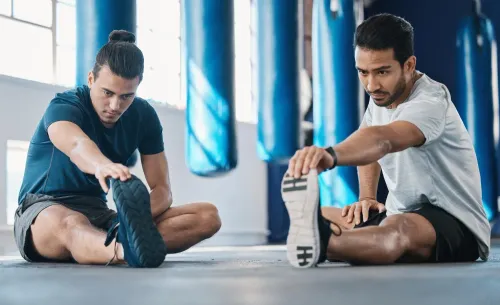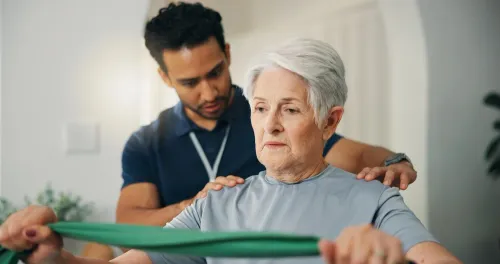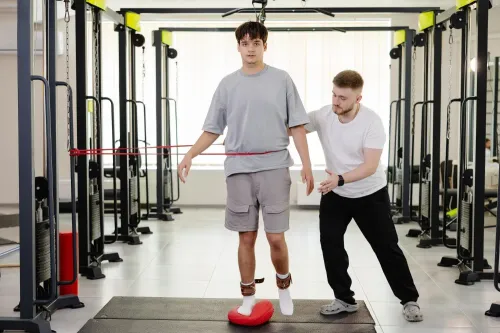
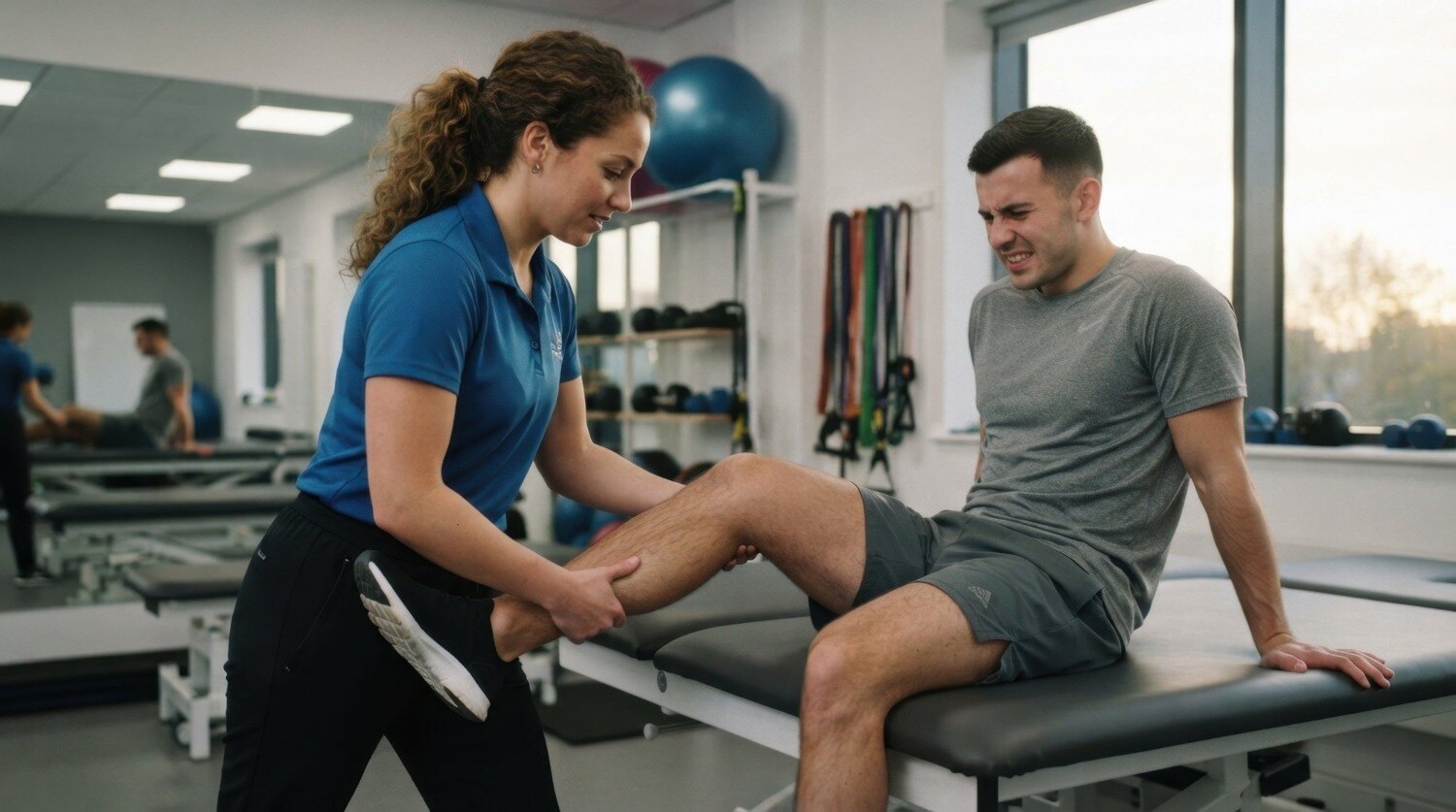
Hands-on treatment and active training solve different problems after an ankle sprain, muscle strain, tendon injury, ligament injury, or surgery. You will learn when manual therapy can remove a movement barrier, when strength conditioning must take priority, and how to judge whether your rehabilitation is ready to progress.
Key takeaways
- Use manual therapy to address a specific mobility or symptom barrier.
- Pair hands-on treatment with progressive strengthening, not as a replacement.
- Advance from controlled exercises to sport-specific loading in stages.
- Reduce or adjust load when symptoms worsen during or after training.
What manual therapy changes at each stage of an injury
Manual therapy is introduced after the injury has been assessed and a specific mobility or symptom barrier is identified. It can begin early when pain, swelling, tissue protection, or surgical precautions allow, but it remains an aid to sports injury rehabilitation, not a replacement for progressive exercise.
- Joint mobilization: You should feel a firm, controlled pressure or a gentle glide, not sharp pain. It aims to improve a restricted joint movement, such as ankle dorsiflexion after a sprain, so you can perform exercises with better mechanics.
- Soft-tissue work: Expect focused pressure through muscle or surrounding tissue, with tenderness that settles rather than escalating. The aim is to reduce a temporary feeling of tightness and make active movement easier.
- Massage: This should feel rhythmic and tolerable, not like bruising. It may reduce soreness or perceived stiffness before exercise, but it does not rebuild muscle capacity.
- Therapist-assisted stretching: You should feel a steady stretch that stops before pain, guarding, or tingling. It targets a specific range-of-motion loss and should be followed by active movement to retain the change.
- Manipulation: A brief thrust may produce a quick movement or pressure sensation. It is used selectively for a joint restriction, never to force an unstable, acutely injured, or surgically protected area.
- Scar-tissue mobilization: After the incision has healed and the surgeon’s precautions permit it, expect gentle pressure around and across the scar. The goal is to improve skin and tissue movement, not to break open adhesions forcefully.
The lasting gains come mainly from repeated, appropriately dosed strength conditioning, balance work, and sport-specific loading. Reassess whether range, pain, movement quality, or exercise tolerance actually improved after manual therapy.
How hands-on treatment and strengthening work together
A useful session has a handoff: manual therapy addresses a temporary barrier, then strength conditioning uses the improved movement to build capacity. The treatments are not competing choices; one prepares the body for the other.
- Test the limitation first: record pain, range of motion, swelling, strength, or movement quality.
- Apply the selected technique only when it targets that limitation, such as joint mobilization for restricted ankle dorsiflexion or soft-tissue work for a painful, guarded muscle.
- Re-test the same measure, then use the available improvement during active exercise rather than treating it as the final result.
The exercise dose must match the injured tissue, surgical precautions, symptoms, and sport demands. Isometrics may suit an irritable tendon, while loaded calf raises, split squats, or single-leg balance belong when the person can tolerate more force and control.
Manual therapy can make a movement less painful or easier for a short period. It does not restore tendon capacity, muscle strength, coordination, or confidence by itself. Repeated, progressive loading creates those adaptations.
For a lateral ankle sprain, a therapist might improve dorsiflexion, then immediately practise calf raises, band resistance, balance, or controlled landing. If the ankle moves better but the person still collapses during a single-leg task, conditioning remains the priority.
A session is working when the hands-on change improves exercise quality, and the exercise produces measurable progress over repeated visits. If the improvement disappears without treatment, reassess the underlying weakness, load tolerance, or movement strategy instead of simply adding more massage.
The progression from basic exercises to sport-specific loading
Passing a calendar milestone does not prove readiness. Sports injury rehabilitation strength conditioning should advance when you can control the current task, produce force, and tolerate its next-day response—not simply because several weeks have passed.
| Stage | Sports rehabilitation exercises | What it must establish |
|---|---|---|
| Movement | Heel slides, ankle mobility, gentle stretching, and pain-limited joint motion | Restored range without increased swelling or protective guarding |
| Force | Isometric quadriceps or hamstring contractions, calf raises, and resistance-band work | Useful muscle activation and tolerable force production |
| Load | Split squats, step-ups, heavier calf raises, and progressively loaded hamstring exercises | Symmetrical strength through a fuller range, including controlled lengthening |
| Single-leg control | Single-leg balance, reaches, single-leg squats, and landing-position holds | Stable knee, hip, ankle, and trunk alignment under unilateral load |
| Running and jumping | Walk-jog intervals, accelerations, pogo jumps, skipping, and repeated jump-landings | Absorption and production of force at increasing speed and impact |
| Sport demands | Sprints, deceleration, cutting, reactive direction changes, and drills performed under fatigue | Repeated high-speed efforts, decision-making, and movement quality when tired |
A pain-free jog does not clear a hamstring for maximal sprinting, and isolated quadriceps strength does not guarantee a safe landing. For tendon injuries, progress from tolerable isometric or slow resistance to heavier, faster, elastic, and sport-specific loading so the tissue meets the energy-storage demands of running, jumping, or cutting.
Use manual therapy only to address a restriction that limits this active progression.
How to progress load without provoking a setback
Increase only one training variable at a time, and only when the current workload produces controlled movement and a normal next-day response. In strength conditioning physiotherapy, time since injury is less useful than demonstrated capacity.
1. Keep exercise pain within the agreed limit, commonly no more than 2 or 3 out of 10, with no sharp pain, giving-way, or spreading symptoms. Stop and reassess if pain changes your movement.
2. Progress range of motion when the current range is comfortable and does not worsen swelling or stiffness afterward. Do not force a newly available range after manual therapy; use it actively before adding resistance.
3. Add repetitions within the prescribed range first, then add a set, then increase resistance. Change only one of those variables in a session so you know what caused a flare-up.
4. Keep the same load when technique deteriorates. A knee collapsing inward, trunk twisting, limping, shortened movement, or loss of balance means the exercise is too demanding, even if you complete every repetition.
5. Rest long enough to preserve quality. Use longer rests for heavy strength or power work; shorten rest only when the sport requires fatigue tolerance and the movement remains controlled.
6. Check the following morning: pain, swelling, range of motion, walking, and confidence should be at baseline or close to it. If symptoms are clearly worse, remove the latest progression and return to the last tolerable dose. Manual therapy can ease pain or stiffness, but it does not replace this loading test.
When you need an assessment rather than more massage
Book an assessment when massage gives short-lived relief but you still cannot explain why movement, strength, or control fails. The decision should follow an examination of joint range, tissue irritability, force, balance, movement quality, and the loads your sport demands.
- Choose manual therapy when a clearly restricted joint, painful soft tissue, scar, or postoperative stiffness blocks an exercise. Its role is to make movement easier; it is not the main way to build lasting capacity.
- Prioritize active conditioning when weakness, poor single-leg control, reduced balance, or early fatigue limits you. Isometrics, resistance work, split squats, calf raises, and balance drills address problems massage cannot train.
- Request an individualized return-to-sport plan when you need sprinting, jumping, cutting, landing, or repeated efforts. Passing a strength test at rest does not prove that you can tolerate maximal speed or fatigue.
- Ask for clinical guidance before loading if you have surgical precautions, swelling that increases, giving-way, sharp pain, loss of motion, or symptoms that worsen the next day.
Strength conditioning physiotherapy matches exercise selection and dosage to the injured tissue, healing stage, and sport rather than a calendar. A manual therapy strength conditioning plan may use hands-on treatment briefly, then turn the improved movement into repeated, progressive practice.
Physiospace By Dr. Pratiksha can help distinguish a mobility barrier from a capacity deficit before you keep paying for massage that does not change performance.
Related services
Sports & Fitness Rehabilitation Physiotherapy – Regain Strength, Mobility & Performance Sports Injury Recovery Physiotherapy is a specialized treatment approach designed to help... View service → |
Orthopedic Rehabilitation Ligament & Sports Injury Management Physiotherapy in Vadodara Recover faster and return to your active lifestyle with professional Ligament & Sports Injury Management Physiotherapy... View service → |
Frequently asked questions
When is manual therapy used during sports injury rehabilitation?
It is used after assessment identifies a specific mobility or symptom barrier and when pain, swelling, tissue protection, or surgical precautions allow.
How do manual therapy and strength conditioning work together?
Manual therapy can improve symptoms or movement, while strengthening builds the capacity needed for sport and reduces reliance on hands-on treatment.
How do sports rehabilitation exercises progress to sport-specific loading?
Progress from basic, controlled exercises to heavier resistance, faster movements, change of direction, and drills that match your sport.
How can you increase rehabilitation load without causing a setback?
Change one training demand at a time, monitor symptoms during and after exercise, and reduce the load when symptoms remain elevated.
When do you need an assessment instead of more massage?
Seek an assessment when pain persists, movement remains limited, strength is not improving, symptoms recur with loading, or massage provides only short-term relief.
Related service
Sports & Fitness Rehabilitation Physiotherapy in Vadodara is a specialized rehabilitation and performance enhancement service designed to improve strength, mobility, endurance,... View service → |
Keywords